88231f2b41
Skeleton commit for the subdirectory deployment refactor. Adds the test
framework and one example test per layer; the helpers themselves are
stubbed so the suite is meaningfully red until the green commit lands.

Frameworks
- spec/helpers/withApplicationRoot.ts: fixture that rewrites #app data
  and resets the module cache so getBootstrapData() returns the requested
  application root inside the callback. Replaces the inline ritual that
  pathUtils.test.ts currently repeats per test.
- spec/helpers/sourceTreeScanner.ts: line-by-line regex scanner over the
  source tree with allow-list support. Backs the static-invariant tests
  in Layer 2 with workspace-relative file:line locations on failure.

Stubs
- src/utils/navigationUtils.ts: openInNewTab, redirect, redirectReplace,
  getShareableUrl, AppLink. Each throws a "not implemented" error with a
  doc comment describing the channel rule it enforces. Existing
  navigateTo / navigateWithState are kept untouched and called out as
  legacy multi-mode helpers scheduled for replacement.
- packages/superset-ui-core/src/connection/normalizeBackendUrls.ts:
  conservative URL field normaliser. Ships the curated NORMALIZED_URL_FIELDS
  set (initially empty pending per-endpoint audit) and a documented
  NORMALIZER_EXCLUSIONS list explaining why bug_report_url, thumbnail_url,
  user_login_url, etc. are deliberately not normalised.

Layered tests (one example each; full suite expands per layer in
subsequent commits on this PR)
- Layer 1 unit: navigationUtils.test.ts exercises openInNewTab under
  empty / single / nested application roots, plus absolute-URL and
  mailto passthrough. Red until the helper is implemented.
- Layer 2 invariant: navigationUtils.invariants.test.ts asserts that
  ensureAppRoot / makeUrl are not imported outside navigationUtils.ts.
  Allow-list seeded with the 19 current call sites so the test is GREEN
  on day one; migration commits delete entries from the list.
- Layer 3 normaliser: normalizeBackendUrls.test.ts pairs a positive
  strip case with negative passthrough cases (non-allow-listed field,
  absolute URL, similar-but-different prefix segment, empty root).
  Red until the normaliser is implemented.
- Layer 4 contract: SupersetClientAppRootContract.test.ts pins the
  channel-2 invariant (root applied exactly once, never doubled).
  Documents the double-prefix symptom in a regression assertion.
- Layer 5 regression: SliceHeaderControls.subdirectory.test.tsx
  asserts Cmd-click "Edit chart" opens a prefixed URL when the app
  is deployed under a subdirectory. Red until index.tsx:266 is
  migrated to openInNewTab.

Strategy: each subsequent commit on this PR fans out one layer to its
full coverage and migrates the corresponding call sites, shrinking the
Layer 2 allow-list in lockstep.

Co-Authored-By: Claude Opus 4.7 (1M context) <noreply@anthropic.com>
Superset













A modern, enterprise-ready business intelligence web application.
Documentation
- User Guide — For analysts and business users. Explore data, build charts, create dashboards, and connect databases.
- Administrator Guide — Install, configure, and operate Superset. Covers security, scaling, and database drivers.
- Developer Guide — Contribute to Superset or build on its REST API and extension framework.
Why Superset? | Supported Databases | Release Notes | Get Involved | Resources | Organizations Using Superset
Why Superset?
Superset is a modern data exploration and data visualization platform. Superset can replace or augment proprietary business intelligence tools for many teams. Superset integrates well with a variety of data sources.
Superset provides:
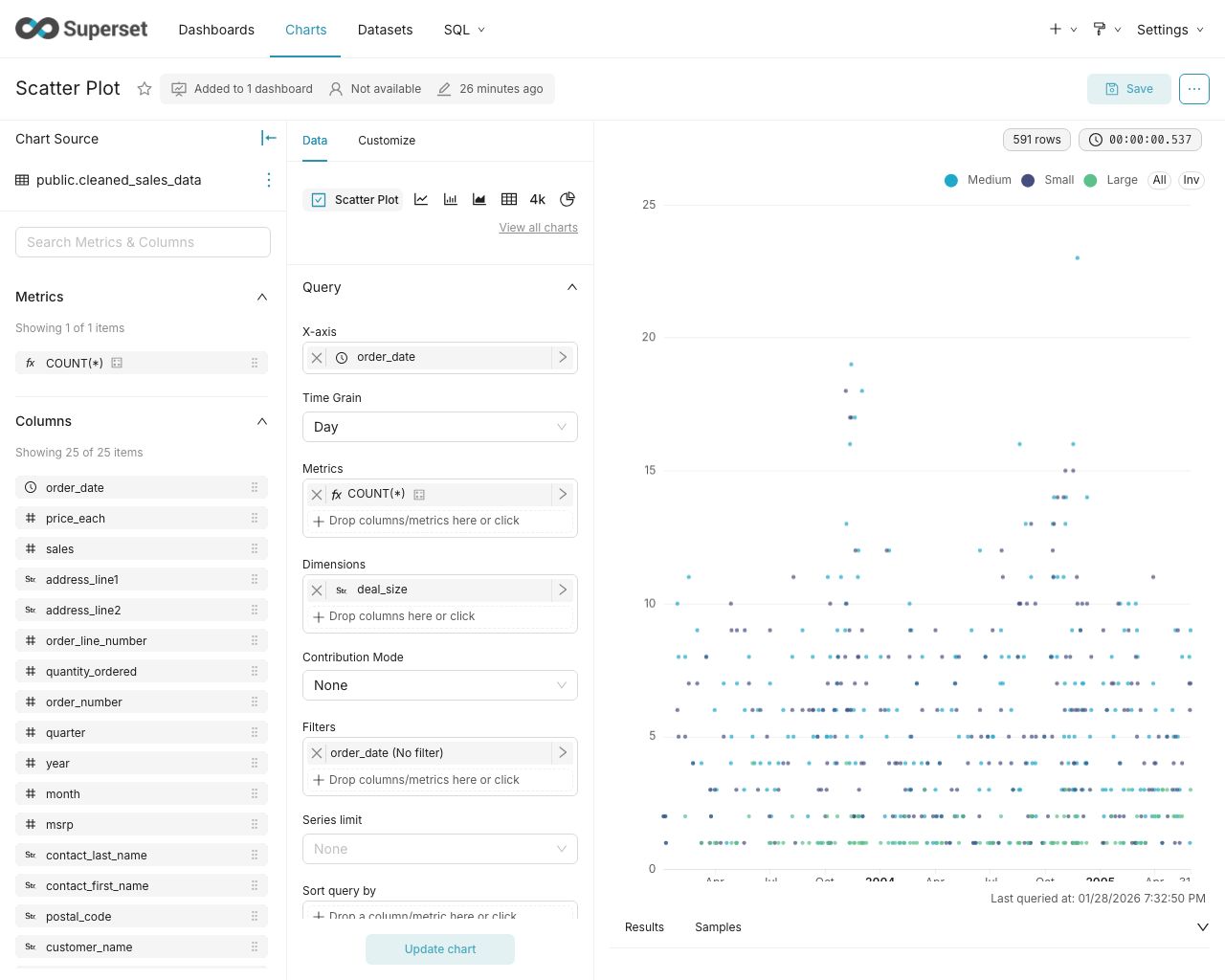
- A no-code interface for building charts quickly
- A powerful, web-based SQL Editor for advanced querying
- A lightweight semantic layer for quickly defining custom dimensions and metrics
- Out of the box support for nearly any SQL database or data engine
- A wide array of beautiful visualizations to showcase your data, ranging from simple bar charts to geospatial visualizations
- Lightweight, configurable caching layer to help ease database load
- Highly extensible security roles and authentication options
- An API for programmatic customization
- A cloud-native architecture designed from the ground up for scale
Screenshots & Gifs
Video Overview
Large Gallery of Visualizations

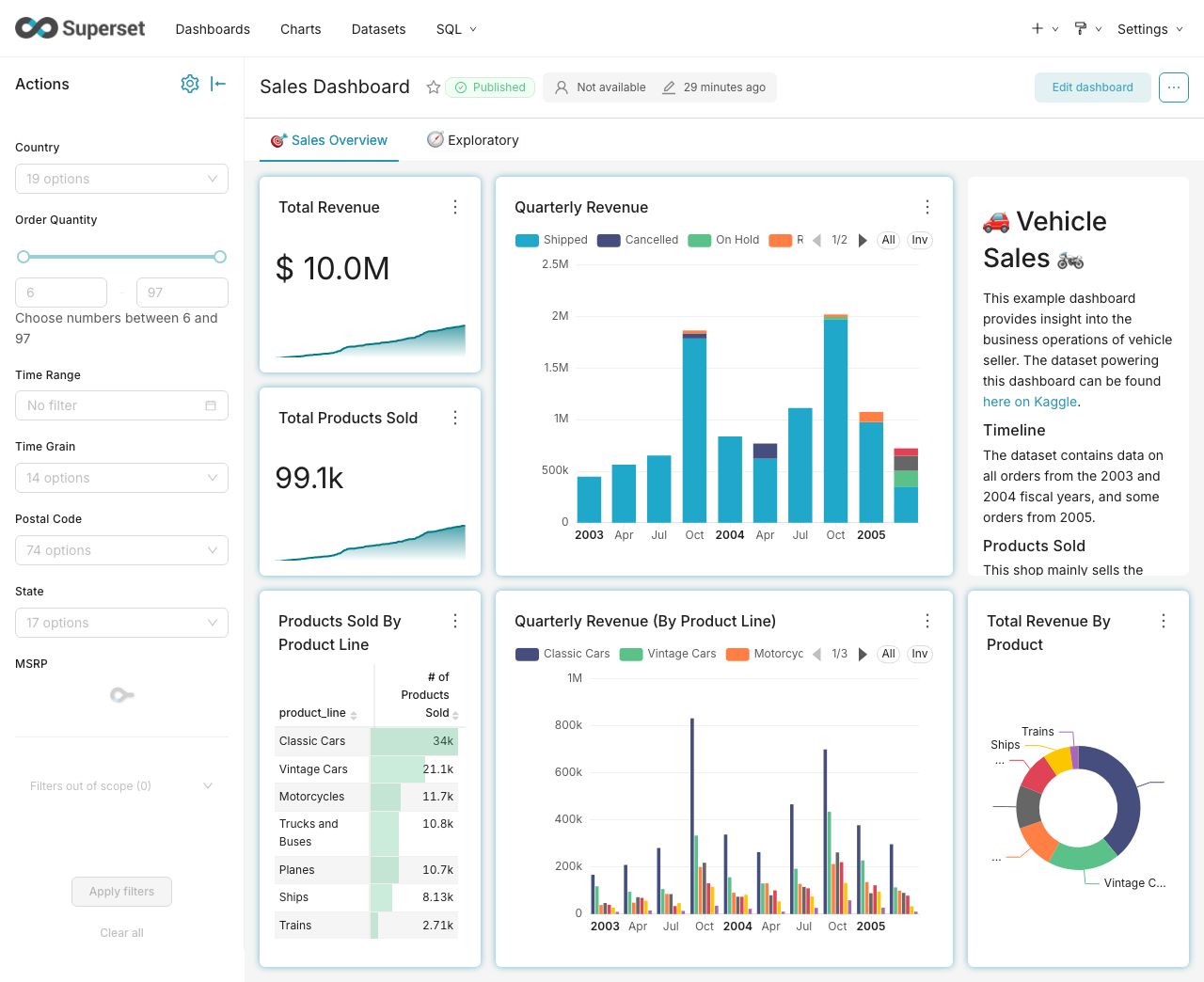
Craft Beautiful, Dynamic Dashboards
No-Code Chart Builder
Powerful SQL Editor

Supported Databases
Superset can query data from any SQL-speaking datastore or data engine (Presto, Trino, Athena, and more) that has a Python DB-API driver and a SQLAlchemy dialect.
Here are some of the major database solutions that are supported:








A more comprehensive list of supported databases along with the configuration instructions can be found here.
Want to add support for your datastore or data engine? Read more here about the technical requirements.
Installation and Configuration
Try out Superset's quickstart guide or learn about the options for production deployments.
Get Involved
- Ask and answer questions on StackOverflow using the apache-superset tag
- Join our community's Slack and please read our Slack Community Guidelines
- Join our dev@superset.apache.org Mailing list. To join, simply send an email to dev-subscribe@superset.apache.org
- If you want to help troubleshoot GitHub Issues involving the numerous database drivers that Superset supports, please consider adding your name and the databases you have access to on the Superset Database Familiarity Rolodex
- Join Superset's Town Hall and Operational Model recurring meetings. Meeting info is available on the Superset Community Calendar
Contributor Guide
Interested in contributing? Check out our Developer Guide to find resources around contributing along with a detailed guide on how to set up a development environment.
Resources
- Superset "In the Wild" - see who's using Superset, and add your organization to the list!
- Feature Flags - the status of Superset's Feature Flags.
- Standard Roles - How RBAC permissions map to roles.
- Superset Wiki - Tons of additional community resources: best practices, community content and other information.
- Superset SIPs - The status of Superset's SIPs (Superset Improvement Proposals) for both consensus and implementation status.
Understanding the Superset Points of View
-
Getting Started with Superset
-
Deploying Superset
-
Recordings of Past Superset Community Events
-
Visualizations
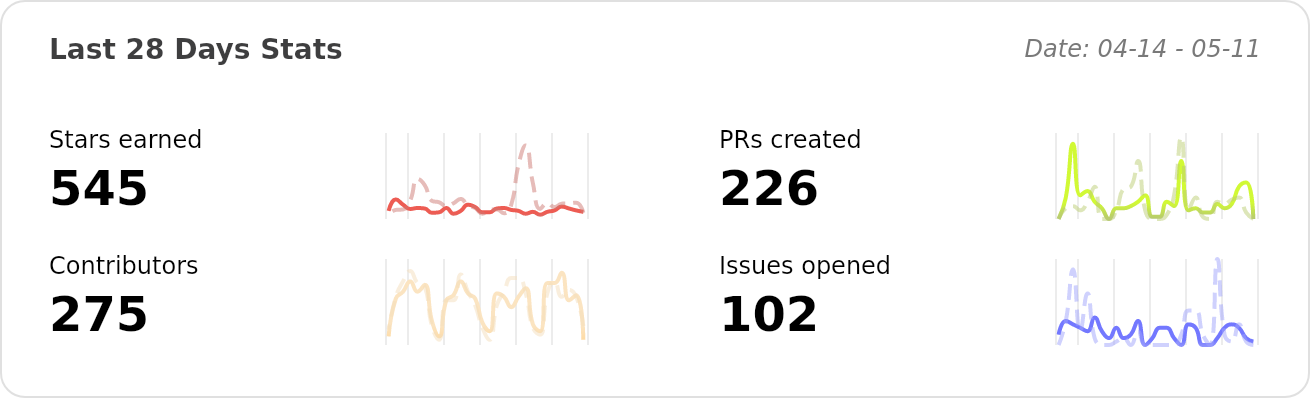
Repo Activity