 Elizabeth ThompsonandClaude
9bbf97b60d
Elizabeth ThompsonandClaude
9bbf97b60d
Enriches the report readiness/capture log lines with the per-state
holder breakdown proven out in production:

- ChartHolderDiagnostics (report_execution.py): structured counts
  separating capture readiness from semantic success, with
  TERMINAL_CHART_HOLDER_STATES and the explicit
  CHART_HOLDER_SEMANTIC_POLICY=deliver_terminal_errors_with_warning.
- report_readiness_poll/_ready/_terminal now carry rendered/empty/
  error/virtualized/unready counts and semantic_success on both the
  Playwright and Selenium paths.
- report_readiness_tile: per-tile readiness diagnostics during tiled
  capture, with each holder's strongest observed terminal state
  aggregated across tiles for the final ready line.
- report_semantic_status: a WARNING whenever capture readiness is
  satisfied but the artifact contains terminal chart errors — delivery
  is not semantic completeness, and this makes the distinction
  operator-visible (and alertable) per tile and per capture.
- Restores the explicit zero-holder thumbnail diagnostic on the
  no-context path.

Logging-only: no readiness predicate, budget, or delivery behavior
changes. Unit tests pin the diagnostics counts and the enriched line
formats.

Co-Authored-By: Claude <noreply@anthropic.com>
Superset















A modern, enterprise-ready business intelligence web application.
Documentation
- User Guide — For analysts and business users. Explore data, build charts, create dashboards, and connect databases.
- Administrator Guide — Install, configure, and operate Superset. Covers security, scaling, and database drivers.
- Developer Guide — Contribute to Superset or build on its REST API and extension framework.
Why Superset? | Supported Databases | Release Notes | Get Involved | Resources | Organizations Using Superset
Why Superset?
Superset is a modern data exploration and data visualization platform. Superset can replace or augment proprietary business intelligence tools for many teams. Superset integrates well with a variety of data sources.
Superset provides:
- A no-code interface for building charts quickly
- A powerful, web-based SQL Editor for advanced querying
- A lightweight semantic layer for quickly defining custom dimensions and metrics
- Out of the box support for nearly any SQL database or data engine
- A wide array of beautiful visualizations to showcase your data, ranging from simple bar charts to geospatial visualizations
- Lightweight, configurable caching layer to help ease database load
- Highly extensible security roles and authentication options
- An API for programmatic customization
- A cloud-native architecture designed from the ground up for scale
Screenshots & Gifs
Video Overview
Large Gallery of Visualizations

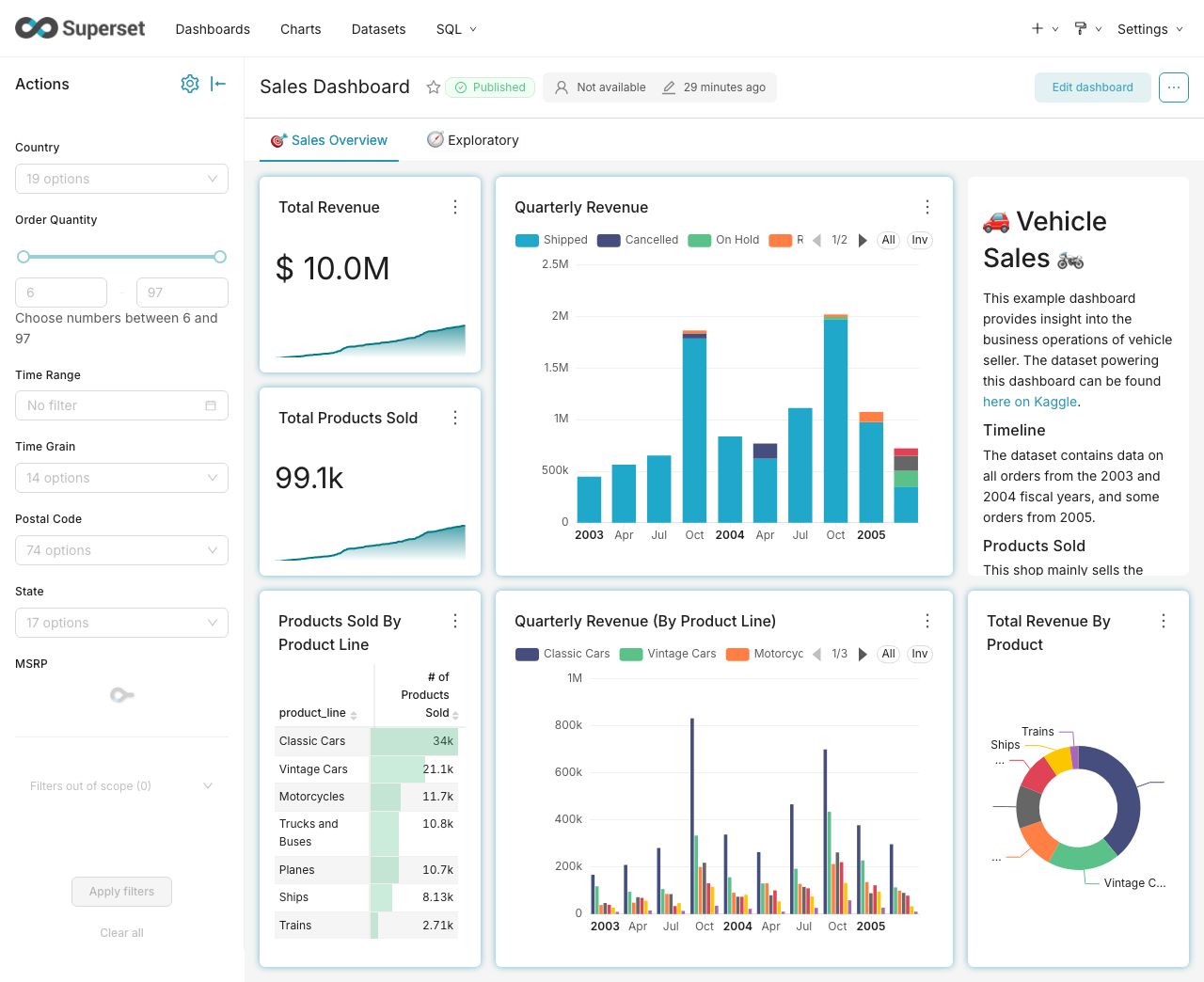
Craft Beautiful, Dynamic Dashboards
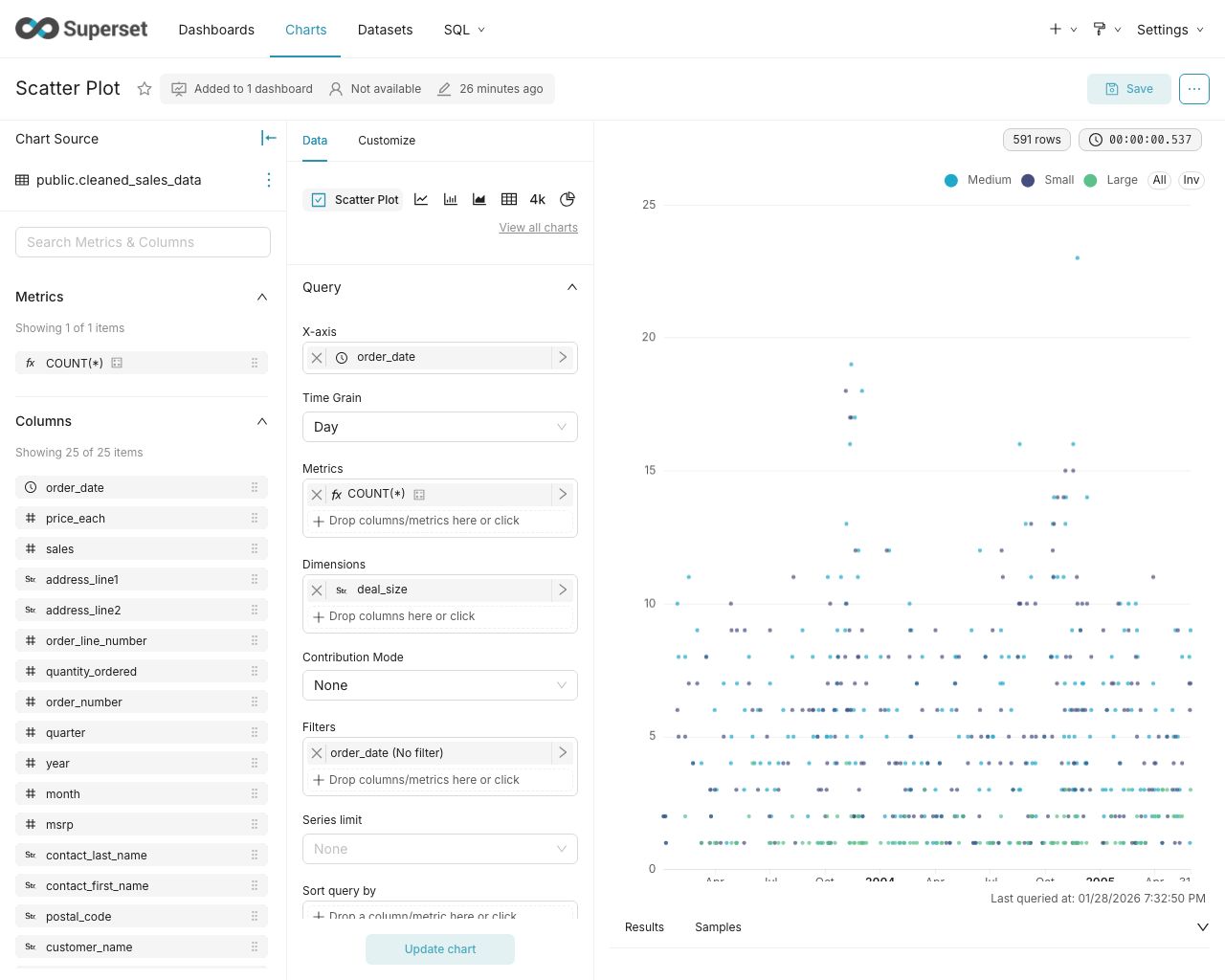
No-Code Chart Builder
Powerful SQL Editor

Supported Databases
Superset can query data from any SQL-speaking datastore or data engine (Presto, Trino, Athena, and more) that has a Python DB-API driver and a SQLAlchemy dialect.
Here are some of the major database solutions that are supported:


A more comprehensive list of supported databases along with the configuration instructions can be found here.
Want to add support for your datastore or data engine? Read more here about the technical requirements.
Installation and Configuration
Try out Superset's quickstart guide or learn about the options for production deployments.
Get Involved
- Ask and answer questions on StackOverflow using the apache-superset tag
- Join our community's Slack and please read our Slack Community Guidelines
- Join our dev@superset.apache.org Mailing list. To join, simply send an email to dev-subscribe@superset.apache.org
- Follow us on social media: X | LinkedIn | Bluesky | Reddit
- If you want to help troubleshoot GitHub Issues involving the numerous database drivers that Superset supports, please consider adding your name and the databases you have access to on the Superset Database Familiarity Rolodex
- Join Superset's Town Hall and Operational Model recurring meetings. Meeting info is available on the Superset Community Calendar
Contributor Guide
Interested in contributing? Check out our Developer Guide to find resources around contributing along with a detailed guide on how to set up a development environment.
Resources
- Superset "In the Wild" - see who's using Superset, and add your organization to the list!
- Feature Flags - the status of Superset's Feature Flags.
- Standard Roles - How RBAC permissions map to roles.
- Superset Wiki - Tons of additional community resources: best practices, community content and other information.
- Superset SIPs - The status of Superset's SIPs (Superset Improvement Proposals) for both consensus and implementation status.
Understanding the Superset Points of View
-
Getting Started with Superset
-
Deploying Superset
-
Recordings of Past Superset Community Events
-
Visualizations
