bfc1debb6a
Add PER_CHART_DASHBOARD_REPORTS feature flag (default off). When enabled,
dashboard reports capture each chart individually and stack the images in
a single column, instead of one monolithic full-dashboard screenshot.

The report scheduler navigates to the dashboard permalink once — so tab
state and dashboard filters apply to every chart — then iterates over each
chart holder, waiting only for that chart's own loading spinner before
capturing it. One slow chart can no longer block or blank the entire
report; charts that never finish loading are skipped with a warning while
the rest are still delivered.

This mirrors the per-component delivery model used by Metabase (per-card
subscriptions) and Looker ("arrange dashboard tiles in a single column").

- take_per_chart_screenshots() in screenshot_utils.py: per-chart iteration,
  scroll-into-view for lazy loading, per-chart spinner wait, skip-on-timeout
- WebDriverPlaywright.get_per_chart_screenshots(): single navigation with
  auth and permalink context, Playwright-only
- DashboardScreenshot.get_per_chart_screenshots(): returns None on Selenium
  so callers fall back to the full-dashboard screenshot
- _get_screenshots() in execute.py: uses per-chart capture for dashboard
  reports when the flag is on; falls back to the full screenshot if no
  charts were captured
- Existing build_pdf_from_screenshots() stacks the per-chart images as PDF
  pages; PNG/Slack formats already accept image lists

POC for sc-113551. Not yet included: per-report-schedule toggle in the UI,
chart title/header treatment, placeholder for skipped charts.

Co-Authored-By: Claude Fable 5 <noreply@anthropic.com>
Superset













A modern, enterprise-ready business intelligence web application.
Documentation
- User Guide — For analysts and business users. Explore data, build charts, create dashboards, and connect databases.
- Administrator Guide — Install, configure, and operate Superset. Covers security, scaling, and database drivers.
- Developer Guide — Contribute to Superset or build on its REST API and extension framework.
Why Superset? | Supported Databases | Release Notes | Get Involved | Resources | Organizations Using Superset
Why Superset?
Superset is a modern data exploration and data visualization platform. Superset can replace or augment proprietary business intelligence tools for many teams. Superset integrates well with a variety of data sources.
Superset provides:
- A no-code interface for building charts quickly
- A powerful, web-based SQL Editor for advanced querying
- A lightweight semantic layer for quickly defining custom dimensions and metrics
- Out of the box support for nearly any SQL database or data engine
- A wide array of beautiful visualizations to showcase your data, ranging from simple bar charts to geospatial visualizations
- Lightweight, configurable caching layer to help ease database load
- Highly extensible security roles and authentication options
- An API for programmatic customization
- A cloud-native architecture designed from the ground up for scale
Screenshots & Gifs
Video Overview
Large Gallery of Visualizations

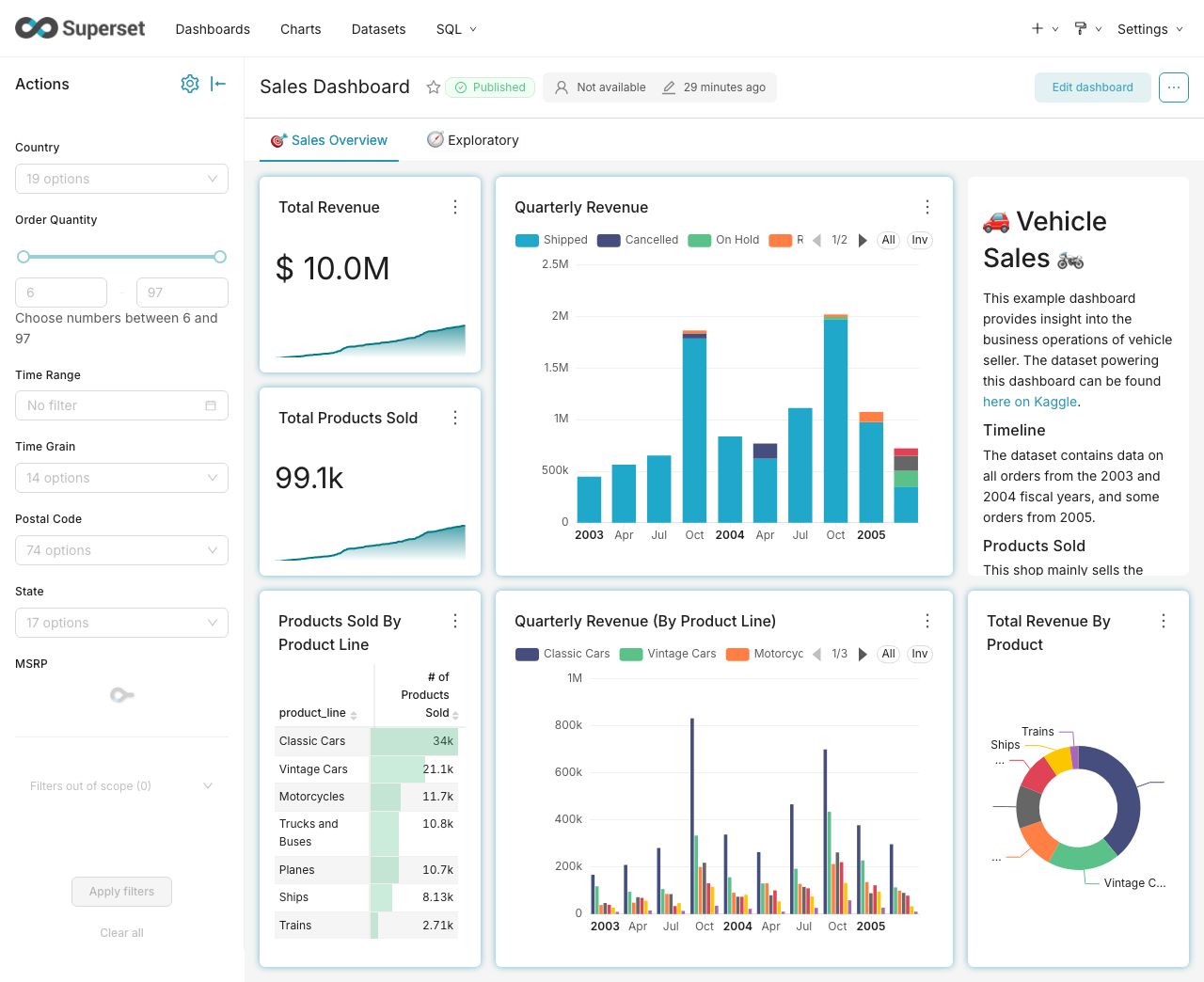
Craft Beautiful, Dynamic Dashboards
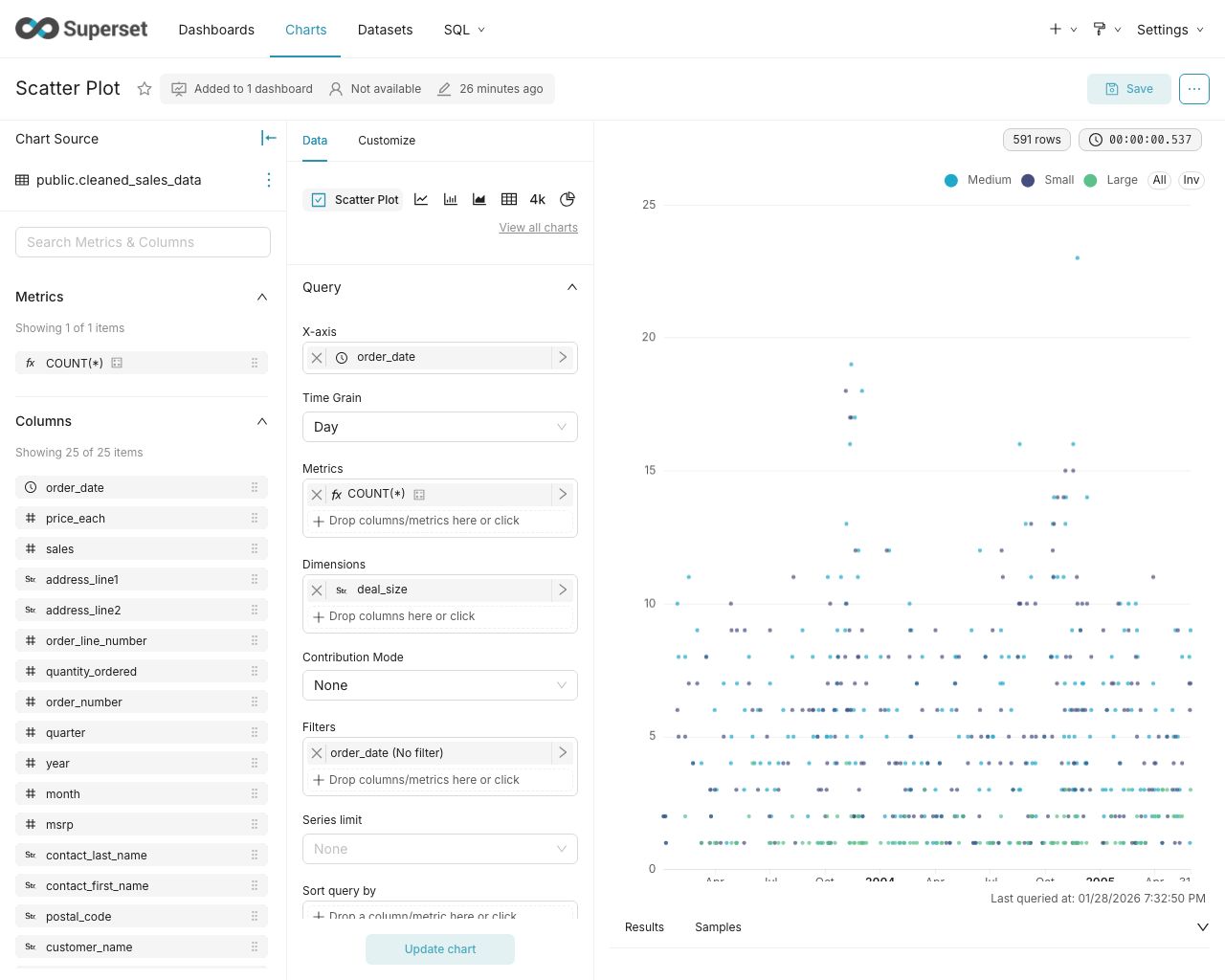
No-Code Chart Builder
Powerful SQL Editor

Supported Databases
Superset can query data from any SQL-speaking datastore or data engine (Presto, Trino, Athena, and more) that has a Python DB-API driver and a SQLAlchemy dialect.
Here are some of the major database solutions that are supported:


A more comprehensive list of supported databases along with the configuration instructions can be found here.
Want to add support for your datastore or data engine? Read more here about the technical requirements.
Installation and Configuration
Try out Superset's quickstart guide or learn about the options for production deployments.
Get Involved
- Ask and answer questions on StackOverflow using the apache-superset tag
- Join our community's Slack and please read our Slack Community Guidelines
- Join our dev@superset.apache.org Mailing list. To join, simply send an email to dev-subscribe@superset.apache.org
- Follow us on social media: X | LinkedIn | Bluesky | Reddit
- If you want to help troubleshoot GitHub Issues involving the numerous database drivers that Superset supports, please consider adding your name and the databases you have access to on the Superset Database Familiarity Rolodex
- Join Superset's Town Hall and Operational Model recurring meetings. Meeting info is available on the Superset Community Calendar
Contributor Guide
Interested in contributing? Check out our Developer Guide to find resources around contributing along with a detailed guide on how to set up a development environment.
Resources
- Superset "In the Wild" - see who's using Superset, and add your organization to the list!
- Feature Flags - the status of Superset's Feature Flags.
- Standard Roles - How RBAC permissions map to roles.
- Superset Wiki - Tons of additional community resources: best practices, community content and other information.
- Superset SIPs - The status of Superset's SIPs (Superset Improvement Proposals) for both consensus and implementation status.
Understanding the Superset Points of View
-
Getting Started with Superset
-
Deploying Superset
-
Recordings of Past Superset Community Events
-
Visualizations
Repo Activity