 Mike BridgeandClaude Opus 4.7
f7d73e2e1b
Mike BridgeandClaude Opus 4.7
f7d73e2e1b
Adds a structured per-field change log alongside the foundational
shadow tables. Each save flush emits zero or more ``version_changes``
rows describing what changed relative to the previous version, with
shape ``[{kind, path, from_value, to_value, sequence}]`` keyed to
``version_transaction.id`` (FR-016 .. FR-021).

**Schema** — ``version_changes`` table, FK to ``version_transaction``
with ``ON DELETE CASCADE`` so retention drops dependent records
without explicit cleanup. Composite unique index on
``(transaction_id, entity_kind, entity_id, sequence)`` so the
listener can write monotonically and downstream readers see a
deterministic order.

**Diff engine** (``superset/versioning/diff.py``) — pure-function
diffing of pre-/post-state pairs:

- ``diff_scalar_fields`` for ordinary columns; emits one record per
  changed field with JSON-safe ``from_value`` / ``to_value``.
- ``diff_json_field`` for ``json_metadata`` and ``params``, walking
  the parsed structure and emitting per-sub-key records. Honours
  an ``exclude_keys`` set
  (``_DASHBOARD_JSON_METADATA_AUDIT_KEYS``: ``chart_configuration``,
  ``global_chart_configuration``, ``map_label_colors``,
  ``show_chart_timestamps``, ``color_namespace``;
  ``_CHART_PARAMS_AUDIT_KEYS``) so frontend-stamped sub-keys that
  mutate on every save don't dominate the change log (FR-022).
- ``diff_dashboard_layout`` walks ``position_json`` structurally
  and emits ``[verb, kind, id]`` records (verbs ``add``, ``remove``,
  ``move``, ``edit``; kinds from a ``CHART``/``ROW``/``COLUMN``/etc.
  → english map) so a UI can render "Added chart 'Foo'" without
  re-parsing JSON. ``HEADER_ID`` is suppressed because it duplicates
  the ``dashboard_title`` scalar record.
- ``fold_dashboard_layout_with_chart_changes`` deduplicates layout
  records against M2M / chart-membership records by UUID so an
  add-and-attach doesn't appear twice.
- ``_values_equivalent`` treats ``None`` and ``""`` as equal; this
  matches the save path's habit of normalising nullable strings to
  the empty string.

**Listener** — ``superset/versioning/changes.py`` registers a
``before_flush`` listener that captures pre-state for each dirty
entity and an ``after_flush`` listener that runs the diff engine
against the post-state and writes ``version_changes`` rows under
the resolved ``transaction_id``. Tracks processed transaction ids
on ``session.info`` so re-firings within a single transaction
(autoflush triggered by mid-commit queries) don't double-insert and
trip the unique constraint. Reads child rows via raw SELECT against
``table_columns`` / ``sql_metrics`` rather than ``dataset.columns``
because the live collection is stale during the restore path's raw
DELETE+INSERT cycle.

**Endpoint surface** — ``VersionDAO.list_change_records_batch``
batches the lookup across multiple transactions with a single
``WHERE transaction_id IN (...)`` query so the version-list
endpoint avoids N+1 round-trips. ``list_versions`` / ``get_version``
return entries with a populated ``changes`` array (empty for
``operation_type=0`` baseline rows).

**Tests** — ``test_diff.py`` covers the diff engine shape (39
unit cases across scalar, JSON, layout, child-collection, and
fold paths). ``change_records_tests.py`` exercises the listener
end-to-end with realistic save flows. ``perf_validation_tests.py``
is the T044 harness for SC-002/3/4 (list endpoint p95 < 1s,
restore < 3s, save overhead < 50ms).

Co-Authored-By: Claude Opus 4.7 (1M context) <noreply@anthropic.com>
Superset













A modern, enterprise-ready business intelligence web application.
Documentation
- User Guide — For analysts and business users. Explore data, build charts, create dashboards, and connect databases.
- Administrator Guide — Install, configure, and operate Superset. Covers security, scaling, and database drivers.
- Developer Guide — Contribute to Superset or build on its REST API and extension framework.
Why Superset? | Supported Databases | Release Notes | Get Involved | Resources | Organizations Using Superset
Why Superset?
Superset is a modern data exploration and data visualization platform. Superset can replace or augment proprietary business intelligence tools for many teams. Superset integrates well with a variety of data sources.
Superset provides:
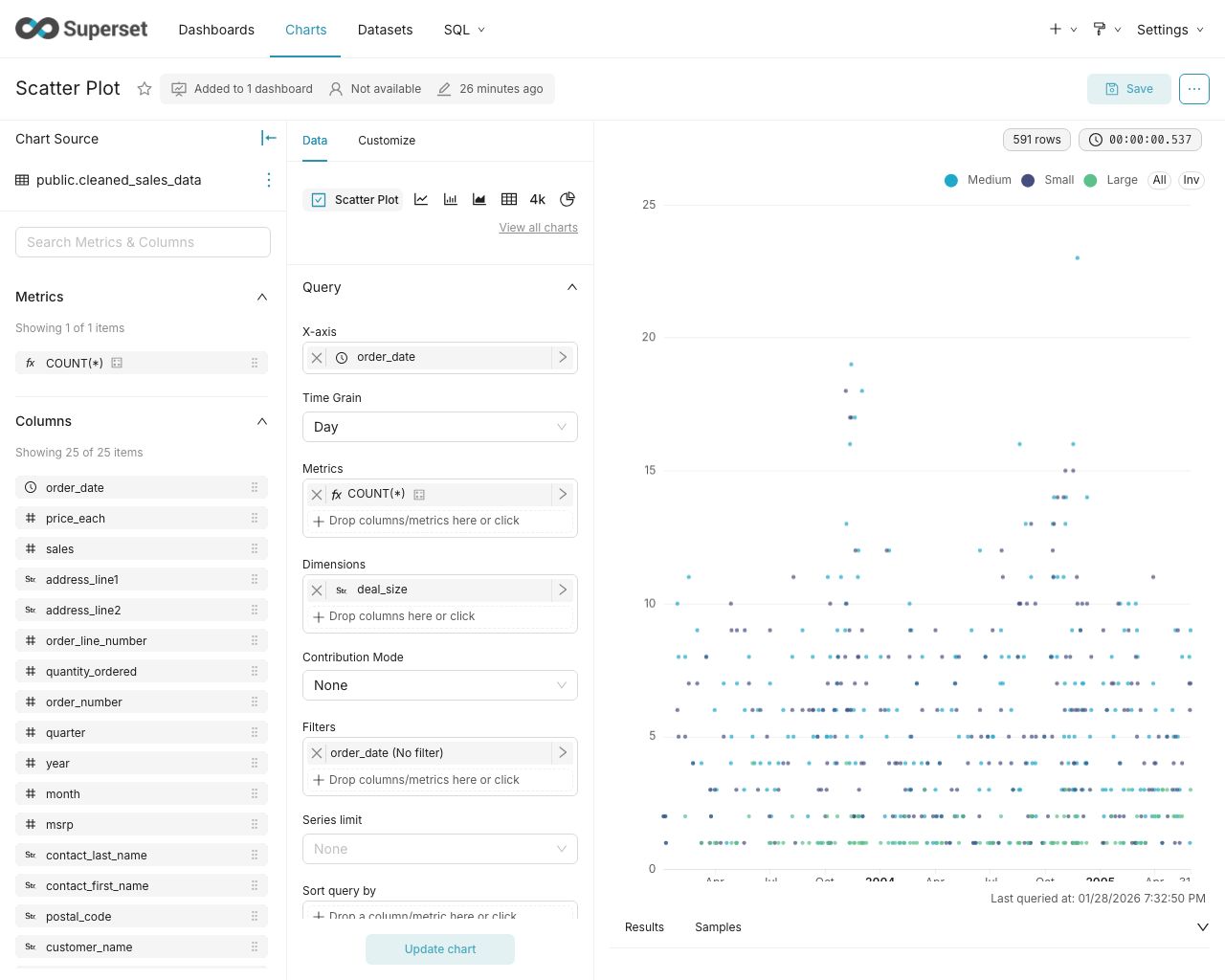
- A no-code interface for building charts quickly
- A powerful, web-based SQL Editor for advanced querying
- A lightweight semantic layer for quickly defining custom dimensions and metrics
- Out of the box support for nearly any SQL database or data engine
- A wide array of beautiful visualizations to showcase your data, ranging from simple bar charts to geospatial visualizations
- Lightweight, configurable caching layer to help ease database load
- Highly extensible security roles and authentication options
- An API for programmatic customization
- A cloud-native architecture designed from the ground up for scale
Screenshots & Gifs
Video Overview
Large Gallery of Visualizations

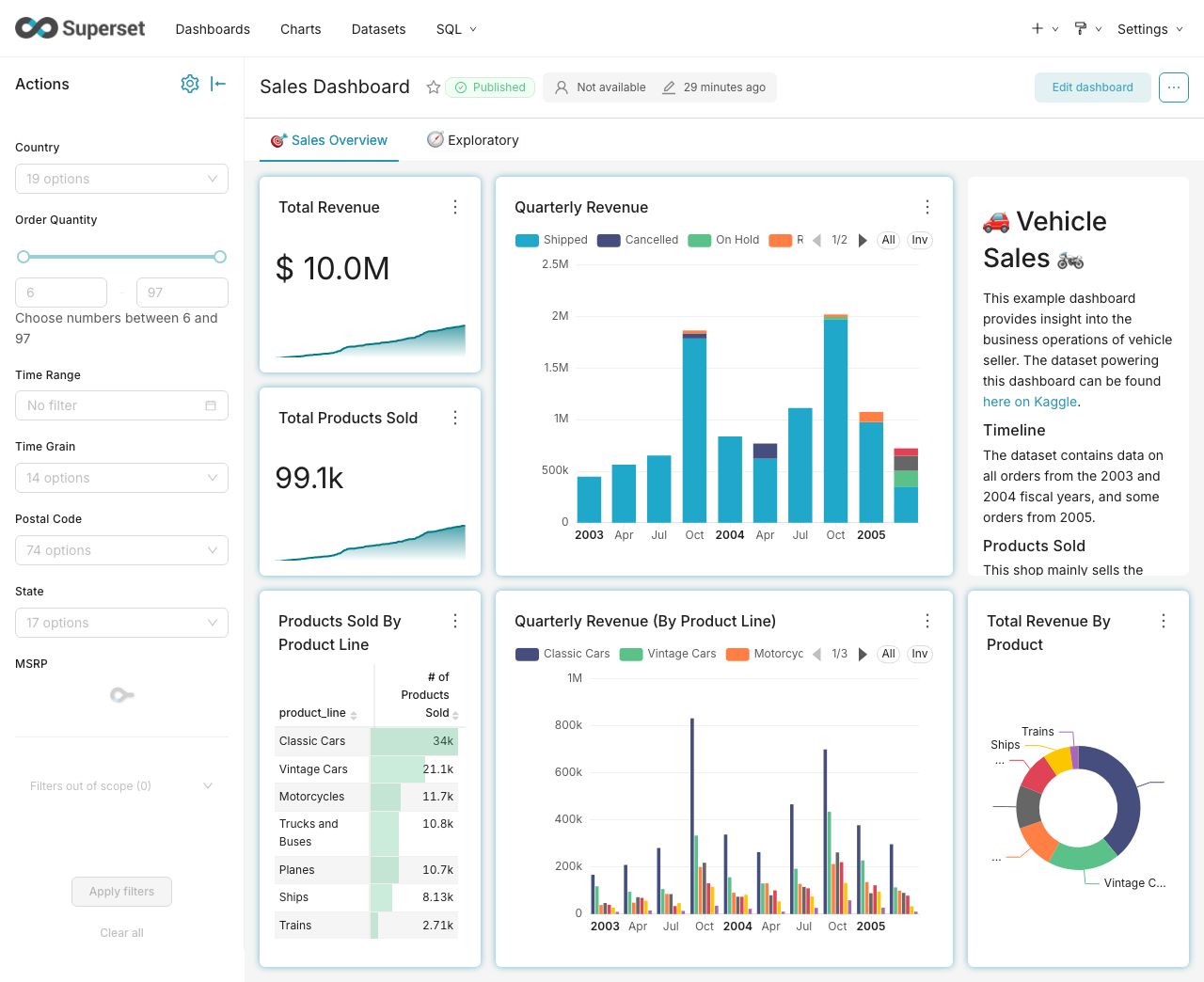
Craft Beautiful, Dynamic Dashboards
No-Code Chart Builder
Powerful SQL Editor

Supported Databases
Superset can query data from any SQL-speaking datastore or data engine (Presto, Trino, Athena, and more) that has a Python DB-API driver and a SQLAlchemy dialect.
Here are some of the major database solutions that are supported:







A more comprehensive list of supported databases along with the configuration instructions can be found here.
Want to add support for your datastore or data engine? Read more here about the technical requirements.
Installation and Configuration
Try out Superset's quickstart guide or learn about the options for production deployments.
Get Involved
- Ask and answer questions on StackOverflow using the apache-superset tag
- Join our community's Slack and please read our Slack Community Guidelines
- Join our dev@superset.apache.org Mailing list. To join, simply send an email to dev-subscribe@superset.apache.org
- If you want to help troubleshoot GitHub Issues involving the numerous database drivers that Superset supports, please consider adding your name and the databases you have access to on the Superset Database Familiarity Rolodex
- Join Superset's Town Hall and Operational Model recurring meetings. Meeting info is available on the Superset Community Calendar
Contributor Guide
Interested in contributing? Check out our Developer Guide to find resources around contributing along with a detailed guide on how to set up a development environment.
Resources
- Superset "In the Wild" - see who's using Superset, and add your organization to the list!
- Feature Flags - the status of Superset's Feature Flags.
- Standard Roles - How RBAC permissions map to roles.
- Superset Wiki - Tons of additional community resources: best practices, community content and other information.
- Superset SIPs - The status of Superset's SIPs (Superset Improvement Proposals) for both consensus and implementation status.
Understanding the Superset Points of View
-
Getting Started with Superset
-
Deploying Superset
-
Recordings of Past Superset Community Events
-
Visualizations
Repo Activity

